
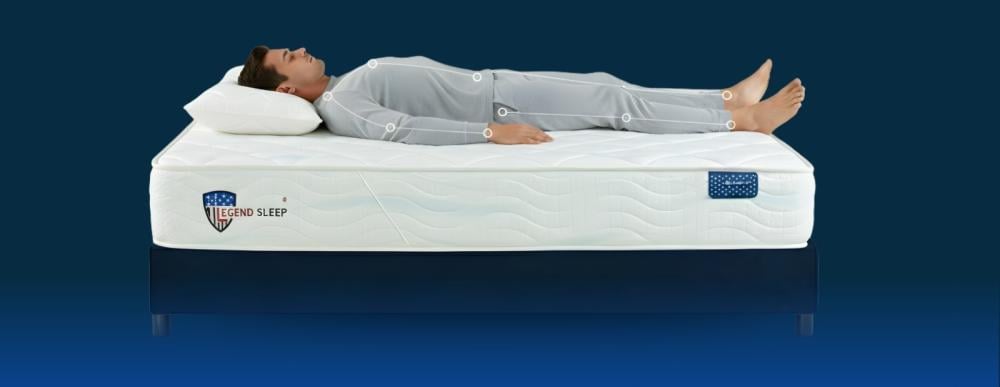

Introduction: “Support” is not just a feeling—it’s a biomechanical science.
When we say that a mattress “supports the body,” what is scientifically meant is: how the mattress distributes your body weight, hugs its curves, and relieves pressure on sensitive points, while keeping the spine in a neutral position .
If you are looking for medical mattresses or want the best and most comfortable mattresses and bed mattresses in Saudi Arabia, understanding these scientific principles will lead you to the right choice instead of guessing.
Learn about Legend Sleep : Legend Sleep website
Browse the section: Mattresses (Arabic)
1) The first scientific basis: spinal alignment (the most important criterion)
The spine has natural curves in the neck, back, and lower back. The ideal mattress is one that maintains these curves without flattening them too much or over-curving them .
What happens when you choose an unsuitable mattress?
- A very soft mattress: The pelvis sinks too deep → Increases the curvature of the lower back → Tightness and fatigue.
- A very firm mattress: shoulders and hips do not sink sufficiently → pressure increases → stiffness and pain.
The desired result:
- You feel that your body is “straight and balanced” while you are lying down, especially in your basic sleeping position.
This is why many people prefer medical mattresses because they often combine support and pressure relief in a thoughtful way.
2) Relieving pressure: Why do the shoulders and hips get tired first?
Body pressure on the mattress is uneven. The most sensitive areas are usually:
- Shoulder (especially for those sleeping on their side)
- Hip (for side or back sleepers)
- Heel (for someone sleeping on their back)
A scientifically sound mattress distributes pressure over a larger area, thus reducing the “hot spots” that cause frequent tossing and turning and disrupt sleep, even if you don’t notice it.
Search for:
- Upper layers that support the body without collapsing
- Comfortable thickness relieves pressure while the support underneath remains strong.
- Materials that respond to your weight in a balanced way
3) Hardness isn't a one-size-fits-all standard—weight changes everything.
Two people may sleep on the same mattress and each one will feel a different firmness!
- Lighter weight sinks less → A “medium” mattress may feel firm.
- The heavier the weight sinks further → The mattress may feel “soft” and appear flimsy and unsupported.
A practical principle based on the scientific idea:
- If you are lighter: “Medium/Medium Soft” will most likely suit you.
- If you are heavier: “Medium Strong/Strong” will likely suit you.
- If the pressure is concentrated in the hip and shoulder: a design that supports specific areas (Zoning) or a hybrid mattress may benefit you.
Here, the meaning of "best" is not the most expensive or the most famous, but the most suitable for your body.
4) Sleeping position: The mattress should match your sleeping position.
Sleeping on your side (more sensitive to pressure)
You need a greater embrace for the shoulders and hips with waist support so that the spine does not sag.
Sleeping on your back (more focused on alignment)
You need support that prevents the pelvis from sinking too much, along with gentle support for the lower back.
Sleeping on your stomach (may strain your lower back)
A very soft mattress may increase the curvature of the lower back.
5) Materials science: What happens inside a mattress?
Materials differ in how they respond to weight, heat, and time.
Memory foam
- Features: Strong hug, pressure relief, and excellent motion isolation
- Note: Quality varies depending on density and some designs may trap heat.
Latex
- Features: Flexible "lever" support, quick response, and often better ventilation
- Sensation: More bouncy than memory foam
Pocket springs
- Features: Excellent ventilation, flexible support and movement, and better motion insulation than traditional springs.
- Note: Quantity alone is not enough—design and top layers are more important.
Hybrid mattresses
- It combines: cuddling + support + ventilation + balance
- Very suitable for couples and for those who change their sleeping position
If you want high-performance bed mattresses , hybrid designs are often a strong choice because they combine multiple advantages into one construction.
6) Zoning and edge support
Some premium mattresses use "zone division" with different firmness levels:
- More flexibility at the shoulders to relieve pressure
- Greater strength at the pelvis to ensure back alignment
Edge support is important if:
- Sharing a bed
- Sleep near the edge
- You want consistency and a better shape over time.
These details increase the value of meticulously designed medical mattresses .
7) Temperature regulation: very important in Saudi Arabia's climate
Excessive heat can reduce deep sleep. Therefore, focus on:
- Breathable fabrics and upper layers
- A design that promotes airflow (especially with springs)
- Materials that do not trap excessive heat
8) A simple, scientific testing method: PPP
Test the ranking using 3 points:
- Posture (Position and Alignment): Is your spine neutral?
- Pressure relief: Is there any bothersome pressure on your shoulder/hip?
- Preferences: Heat, rebound, motion insulation, edge feel
Practical tip: Stretch in your normal sleeping position for 10–15 minutes. If the pressure starts to increase or you feel tightness in your lower back, the support is not suitable.
Why choose Legend Sleep?
The right mattress isn't a luxury—it's essential for your energy levels, focus, and overall well-being. Whether you're comparing orthopedic mattresses or looking for the best mattresses and bed mattresses in Saudi Arabia, start with a variety of options to suit different needs.
Learn about Legend Sleep : Legend Sleep website
Browse the section: Mattresses (Arabic)
Frequently Asked Questions
1) Is a firm mattress better for the back?
Not always. The most important thing is spinal alignment and relieving pressure. If you have persistent pain, consult a specialist.
2) What do medical mattresses mean?
These mattresses often aim to balance support and pressure relief. What matters is the quality of construction and design, not just the name.
3) When should I change my rank?
When a noticeable drop in weight appears, or a loss of support occurs, or there is an increase in tossing and turning during sleep compared to before.